What Is a Live Security Exercise and How Can It Test Your Organisation’s Emergency Response?
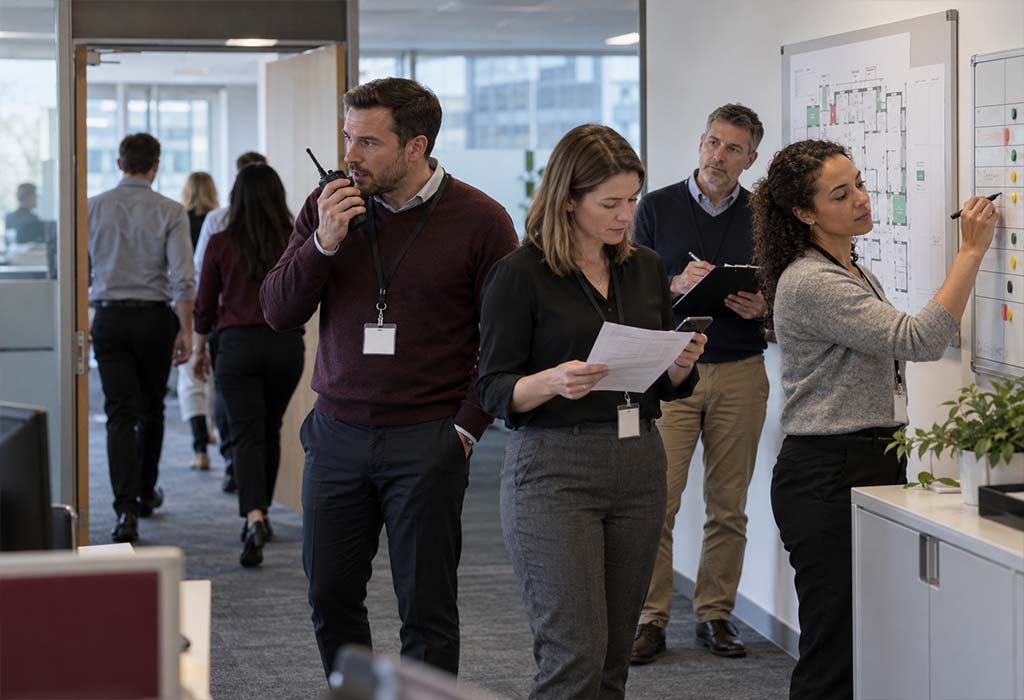
A live security exercise is a controlled simulation in which participants carry out practical actions in response to a realistic scenario. It tests whether people, plans, communications and resources work together when an incident develops, providing evidence that a document review or discussion alone cannot produce.
The exercise should be designed to support learning, not to catch people out. Clear objectives, careful risk management and a structured debrief help the organisation identify strengths and improve its emergency response before a genuine incident occurs.
Why test emergency response in real time?
Plans are often written in calm conditions. A live exercise introduces time pressure, incomplete information, competing priorities and the need for teams to coordinate. These conditions can reveal whether responsibilities are understood and whether information reaches the people who can act.
An exercise may show that a contact list is outdated, a radio cannot be heard in part of a building or two teams expect each other to make the same decision. It may also confirm that training, leadership and procedures are effective. Both findings are valuable.
The purpose is not to predict exactly how every incident will unfold. It is to build capability and test important parts of the response system.
Live exercise, tabletop exercise or test?
Different assurance methods serve different needs.
A tabletop exercise is discussion-based. Participants work through a scenario and explain what they would do. It is useful for clarifying responsibilities, exploring strategic decisions and introducing new plans with relatively low operational disruption.
A live exercise requires practical action. Participants may communicate, deploy to locations, establish control arrangements or carry out parts of the emergency procedure. It produces richer operational evidence but demands more planning.
A specific test may focus on one component, such as an alerting system, emergency contact process or physical control. It can verify functionality without exercising the whole response.
An organisation may progress from tabletop discussion to component testing and then to a live exercise as arrangements mature.
Set clear exercise objectives
The scenario is a tool; the objectives determine value. Broad aims such as “test the plan” are difficult to evaluate. More useful objectives might include:
- assess how quickly a potential incident is recognised and escalated;
- examine decision-making between site and organisational leadership;
- test communications between security, facilities and operations;
- evaluate access control or lockdown procedures;
- confirm how information is shared with employees and stakeholders; or
- assess transition from immediate response to recovery.
Objectives should be realistic for the exercise scale. Trying to test every aspect at once can make evidence difficult to interpret.
Design a credible but controlled scenario
The scenario should reflect credible threats and the organisation’s environment. It may involve unauthorised access, suspicious activity, protest disruption, a security breach or another defined event. Information can be introduced in stages so participants respond to a developing picture.
Realism should never override safety. Simulated weapons, aggressive behaviour, emergency communications or public-facing activity require particularly careful consideration and may be inappropriate. Scenario details should be proportionate to the objective and approved through the organisation’s governance process.
Establish control and safety arrangements
A live exercise needs a control structure separate from the team being exercised. Controllers manage the scenario and can pause, modify or end activity. Evaluators observe and record evidence. Role players may represent other people or organisations within strict instructions.
Planning should address:
- risk assessment and participant welfare;
- exercise boundaries and prohibited actions;
- how simulated messages will be identified;
- how a real incident will be distinguished and managed;
- emergency stop words or procedures;
- first aid, accessibility and safeguarding;
- impact on normal operations; and
- any need to coordinate with emergency services, neighbours or other stakeholders.
All participants should know the safety rules relevant to their role, even where scenario details are restricted.
Decide who needs advance notice
Exercises can be announced, partially notified or limited to a small control group. Restricted notice may test spontaneous response, but it also increases risk. People may experience distress, contact emergency services or take unsafe action if they believe the event is real.
The organisation should select the least risky level of surprise that can meet the objective. Factors include the scenario, workplace, participants, vulnerable people, public access and potential effect on essential operations.
Realism can often be created through timed information and role play without concealing the fact that an exercise is taking place.
Observe systems, not just individuals
Evaluators should gather evidence against the objectives. This may include timings, messages, decisions, deployment, handovers and use of procedures. However, a delay is not automatically an individual’s failure. It may result from unclear authority, unavailable information, poor system design or competing instructions.
Evaluation should recognise effective actions and adaptations as well as weaknesses. The aim is to understand the whole response system and create fair, useful learning.
Run an effective debrief
An immediate debrief allows participants to record what they experienced while details are fresh. A later structured review can compare observations, logs and other evidence against the objectives.
Useful questions include:
- What worked and should be preserved?
- What was expected to happen?
- What actually happened, and why?
- Which information or resources were missing?
- Were responsibilities and escalation routes clear?
- What should change before the next exercise or incident?
Psychological safety supports honest learning. People are less likely to describe uncertainty or error if the exercise is presented as a search for blame.
Turn lessons into measurable improvement
The report should prioritise actions, identify owners and set realistic timescales. Changes may affect plans, contact information, training, equipment, communications or governance. Significant findings may require immediate interim measures while a longer-term solution is developed.
Follow-up is essential. An action being marked complete does not prove that it works. Targeted checks, a tabletop discussion or a later live exercise can confirm whether the improvement achieved the intended result.
How often should live exercises take place?
There is no universal interval. Frequency should reflect risk, organisational change, staff turnover, external requirements and the complexity of the response. Exercises may also be appropriate after a major plan revision or when earlier assurance identified a weakness.
A programme should vary objectives and scenarios rather than repeat an identical event. Smaller tests and tabletop exercises between live activities can maintain readiness without excessive disruption.
Test preparedness without creating unnecessary risk
A well-designed live security exercise provides practical evidence about emergency response and builds confidence through experience. Its value comes from disciplined planning, safe control, objective evaluation and committed follow-up.
Corps Intel provides security assurance and testing services tailored to organisational risks and objectives. Speak to our consultants about planning a proportionate live security exercise that tests coordination, decision-making and response while protecting people and operations.